

Picture this: you're navigating through Brisbane traffic on your way home, or maybe heading out on a weekend road trip, and your iPhone battery suddenly dips into the red. It’s a familiar frustration for millions of Aussies who rely on their iPhones for everything from GPS navigation to streaming music. The problem is, a cheap, slow charger won't cut it. Picking the right charger car iPhone setup isn't just about convenience; it's about protecting your expensive device and ensuring you get a fast, safe charge when you need it most.
Why Your Car Charger Matters More Than You Think
In a world where our iPhones are essential, a dead battery can feel like being cut off completely. The humble car charger has evolved from a simple accessory into a critical piece of kit. Gone are the days of those slow, unreliable plugs that barely kept your battery from draining. Today’s charging technology is a different ball game, with intelligent systems like USB-C Power Delivery (PD) and the magnetic click-and-go convenience of MagSafe. This guide will explain the solution, cutting through the confusion to help you choose a quality setup that unlocks your iPhone's full potential.
 alt text: An iPhone charging in a car holder, demonstrating the need for a reliable car charger.
The Problem with Cheap Chargers
It’s tempting to grab the cheapest charger off the shelf, but this is almost always a false economy. Low-quality chargers can deliver inconsistent, "dirty" power, leading to frustratingly slow charging speeds and, in worse cases, permanent damage to your iPhone's battery and charging port. They often lack the proper safety certifications needed to protect against overheating or power surges, putting both your device and your vehicle's electrical system at risk. A quality charger is an investment in your iPhone's longevity.
The iPhone's Dominance in Australia
The need for reliable charging solutions is more pressing than ever, especially here in Australia. iPhones command a dominant 60% share of the mobile operating system market, making them the go-to choice for millions. This staggering figure highlights why a dependable charger car iPhone system is so critical—any glitch in charging can bring a busy day to a screeching halt. You can explore more iPhone statistics for Australia to see the full scope of this trend. This widespread adoption also explains the high demand for quality iPhone repairs in Brisbane when charging ports inevitably fail.
Choosing the right car charger is about more than just power; it’s about performance and peace of mind. A certified, high-quality charger ensures your iPhone gets the fastest, safest charge possible, protecting your investment for the long haul.
This guide will walk you through everything you need to know. We'll explore the different charger types, explain what the technical jargon means, and help you troubleshoot common issues. Our goal is to keep you powered up and connected, no matter where the road takes you.
Breaking Down Your Charger: USB-C PD and MFi Explained
Stepping into the world of iPhone car chargers can feel like trying to read a foreign language. To make a smart choice, you really only need to understand two key things that separate the good chargers from the bad: USB-C Power Delivery (PD) and MFi Certification. Getting these two right is the secret to setting up a fast, safe, and reliable car charging system.
USB-C Power Delivery: The Brains Behind the Speed
Think of older, traditional USB-A chargers—the rectangular ones we all know—as a standard garden hose. They get the job done, but the flow is slow. A modern USB-C PD charger, on the other hand, is like a high-pressure fire hose. It’s not just about pushing more power; it’s about doing it intelligently. This "intelligence" is the whole point of Power Delivery. It’s a communication protocol that allows your iPhone and the charger to talk to each other, negotiating the fastest and safest charging speed possible. A good PD charger adjusts its output on the fly, ensuring your device gets exactly what it needs without risk.
Watts, Amps, and Volts: The Language of Power
To really appreciate why USB-C PD is such a game-changer, it helps to know the basic language of electricity. We'll keep it simple.
- Volts (V): Think of this as electrical pressure. Higher voltage lets power be pushed more efficiently.
- Amps (A): This is the volume or current of electricity flowing. More amps mean more power is moving.
- Watts (W): This is the total power, which you get by multiplying volts by amps (V x A = W). It’s the single most important number for a fast charger.
A basic USB-A charger might give you 5 volts at 1 amp, resulting in just 5 watts. A modern USB-C PD charger can deliver 20 watts or more. This huge difference is why a PD charger can juice up your iPhone from 0 to 50% in about 30 minutes, while an old 5W charger would take over an hour. With Apple’s move to USB-C, this technology is the new standard. If you want to dive deeper, you can read our guide on the iPhone 15 charging port.
The MFi Badge: Your Guarantee of Safety
Now for the most important seal of approval: MFi Certification. It stands for "Made for iPhone/iPad/iPod," and it’s Apple's official licensing program. When you see that MFi logo, it means the manufacturer has met Apple's incredibly strict standards for quality, safety, and compatibility.
An MFi-certified charger contains a special authentication chip that talks to your iPhone. This chip confirms the accessory is genuine and safe, protecting your phone’s delicate circuitry from damage.
Choosing a non-certified charger is a massive gamble. These cheap knock-offs often skip safety features needed to prevent overheating or power surges. They can deliver inconsistent power that slowly kills your iPhone’s battery health or trigger annoying error messages. In extreme cases, they can permanently damage the charging port—a problem we see all too often in our iPhone Repairs Brisbane workshop.
To make sure you're buying a quality product, follow this simple checklist:
- Look for the MFi Logo: Check the packaging for the official "Made for iPhone" badge.
- Choose Reputable Brands: Stick with well-known brands.
- Avoid "Too Good to Be True" Prices: If a charger is ridiculously cheap, it's almost certainly uncertified.
- Check for USB-C PD: For the fastest charge, make sure the charger explicitly supports Power Delivery.
The Convenience of Wireless MagSafe and Qi Car Charging
Let's be honest, fumbling with a charging cable while driving is a frustrating distraction. Wireless charging is the answer, offering a simple, drop-and-go solution that cleans up your car's interior. In Australia, the wireless charger market hit USD 139.6 million in 2024 and is on track to hit USD 521.5 million by 2030. A big reason for this surge is Apple's adoption of magnetic charging, which has made a quality wireless charger car iPhone setup a must-have for Aussie drivers.
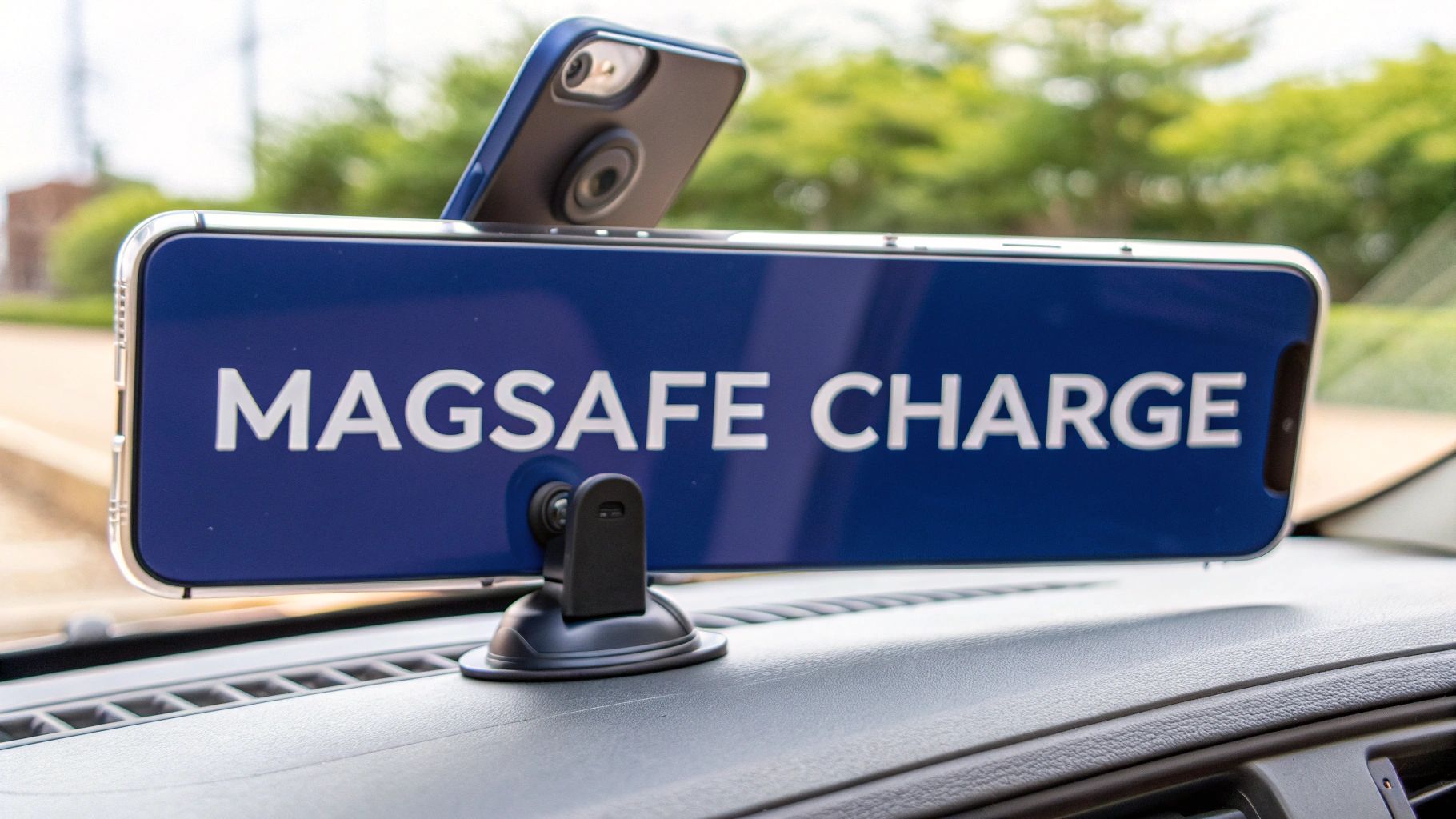 alt text: An iPhone charging wirelessly on a MagSafe car mount in a modern vehicle.
caption: iPhone 14 Pro charging with a MagSafe mount in Brisbane.
alt text: An iPhone charging wirelessly on a MagSafe car mount in a modern vehicle.
caption: iPhone 14 Pro charging with a MagSafe mount in Brisbane.
Understanding Qi and MagSafe
When people talk about "wireless charging," they're almost always talking about one of two standards: Qi (pronounced "chee") or MagSafe. They work on the same basic principle, but the experience is different. To really get it, it helps to understand the basics of how wireless charging works.
-
Qi The Universal Standard: Think of Qi as the open standard that everyone uses. The catch? You have to place your device perfectly on the charging coil. If it's slightly off-centre, you'll get a painfully slow charge, or no charge at all.
-
MagSafe Apple's Magnetic Solution: MagSafe is Apple's clever take on Qi, with one game-changing addition: a ring of powerful magnets. These magnets snap your iPhone into the sweet spot every single time, guaranteeing the fastest, most reliable power delivery. This "snap-and-charge" feature completely solves the alignment headache that makes standard Qi chargers frustrating on bumpy roads.
Wired vs Wireless Car Charging At a Glance
So, should you stick with the speed of a cable or embrace the convenience of wireless? This table breaks down the key differences to help you decide.
| Feature | Wired (USB-C PD) | Wireless (MagSafe/Qi) |
|---|---|---|
| Charging Speed | Fastest. Delivers 20W or more for rapid power-ups. | Slower. MagSafe tops out at 15W; standard Qi is even less. |
| Convenience | Good. Requires plugging and unplugging the cable. | Best. Just place your phone on the mount and go. |
| Cabin Clutter | More clutter. Cables can get tangled and look messy. | Minimal clutter. Creates a clean, cord-free setup. |
| Device Port Wear | Higher risk. Constant plugging can wear out the port over time. | No risk. Preserves the integrity of the charging port. |
| Heat Generation | Minimal. Highly efficient, produces very little heat. | Moderate. Can generate noticeable heat during long sessions. |
| Cost | Generally lower. Cables and plugs are inexpensive. | Generally higher. Mounts with MagSafe tech cost more. |
| Mounting | Separate. Requires a separate mount to hold the phone. | Integrated. The charger and mount are typically one unit. |
Ultimately, wired charging is still the king of raw speed, perfect for when you need a lot of battery in a short time. But for everyday top-ups and sheer ease of use, a MagSafe wireless charger is hard to beat.
Choosing the Right Mount for Your Vehicle
A wireless charger is only as good as the mount holding it in place. The best one comes down to your car's interior. You'll generally find three main types.
A secure mount is non-negotiable. It ensures your iPhone stays put during sharp turns or sudden stops, maintaining a consistent charge and keeping your device safe.
Dash and windscreen mounts use strong suction cups, while vent mounts clip onto your air conditioning vents to keep your phone at eye level. If you're looking for the perfect fit, have a look at our guide to the https://www.fixo.com.au/blogs/news/the-6-best-car-mounts-for-iphone-in-2023.
Choosing the Right Power: How Many Watts Do You Really Need?
Not all chargers are built the same. When it comes to juicing up your iPhone in the car, wattage is king. Picking the right power level for your specific device is the secret to unlocking the fastest, safest charge on the go. It’s a common worry that a high-wattage charger will "fry" an older iPhone, but that's not how modern charging works.
Your iPhone is Smarter Than You Think
Thanks to the clever technology in Power Delivery (PD), your iPhone and charger are always talking. The moment you plug it in, your phone tells the charger exactly how much power it can safely handle. A powerful 20W charger won't blast that full amount into an older iPhone 8 that can only take 12W. Instead, it scales down its output to match what the iPhone asks for.
The biggest myth we need to bust is that a high-wattage charger will damage an older phone. The truth is, your iPhone is in the driver's seat. It only draws the power it needs, making a higher-wattage charger a safe, future-proof investment.
This means you can confidently grab a powerful charger car iPhone solution today, knowing it will safely charge both your current iPhone and any future models.
Matching Watts to Your iPhone Model
While a powerful charger is safe for any iPhone, matching the wattage to your device's capabilities ensures you’re not leaving speed on the table. Here’s a quick guide to what different iPhone generations need.
Recommended Car Charger Wattage for iPhone Models
| iPhone Model Range | Standard Charging (Watts) | Optimal Fast Charging (Watts) |
|---|---|---|
| iPhone 8 – iPhone 11 | 5W – 12W | 18W |
| iPhone 12 – iPhone 14 | 12W – 15W | 20W or more |
| iPhone 15 & Newer | 15W – 20W | 20W or more |
As you can see, for any iPhone from the 12 series onwards, a 20W charger is the sweet spot. This is what you need to hit maximum fast-charging speeds, which can take your battery from nearly empty to 50% in about 30 minutes—an absolute lifesaver.
The Rise of GaN: The Secret to Compact Power
So, how are manufacturers cramming so much power into smaller chargers? The answer is a material called Gallium Nitride, or GaN. GaN is a semiconductor that’s way more efficient than old-school silicon. It can handle higher voltages and runs much cooler, allowing engineers to design chargers that are incredibly small without sacrificing power or safety. The Australian GaN charger market hit USD 53.54 million in 2023 and is expected to rocket to USD 165.78 million by 2030. You can check out more details about the growth of the GaN charger market in Australia. When shopping for your next charger car iPhone setup, keep an eye out for GaN technology.
Troubleshooting Common Car Charging Problems
There’s nothing worse than plugging your iPhone in on a long drive, only to see the battery icon isn't lighting up. When your car charger quits on you, don’t panic—the fix is often simpler than you'd think. Before you assume the worst, a bit of methodical troubleshooting can usually get to the bottom of it.
Start With The Basics: The Cable and Port
Nine times out of ten, the problem is the physical connection. Cables and ports take a beating in a car. First, give your charging cable a good look over. Check for any obvious signs of damage—fraying, kinks, or breaks are dead giveaways. Next, have a close look at your iPhone's charging port. It's amazing how much lint, dust, and gunk can get crammed in there, stopping the cable from making a solid connection.
A surprisingly high number of charging issues are caused by a blocked port. Gently cleaning it out with a non-metallic tool like a wooden toothpick can instantly solve the problem.
If you've cleaned the port and tried a different, working cable with no luck, it's time to check the power source.
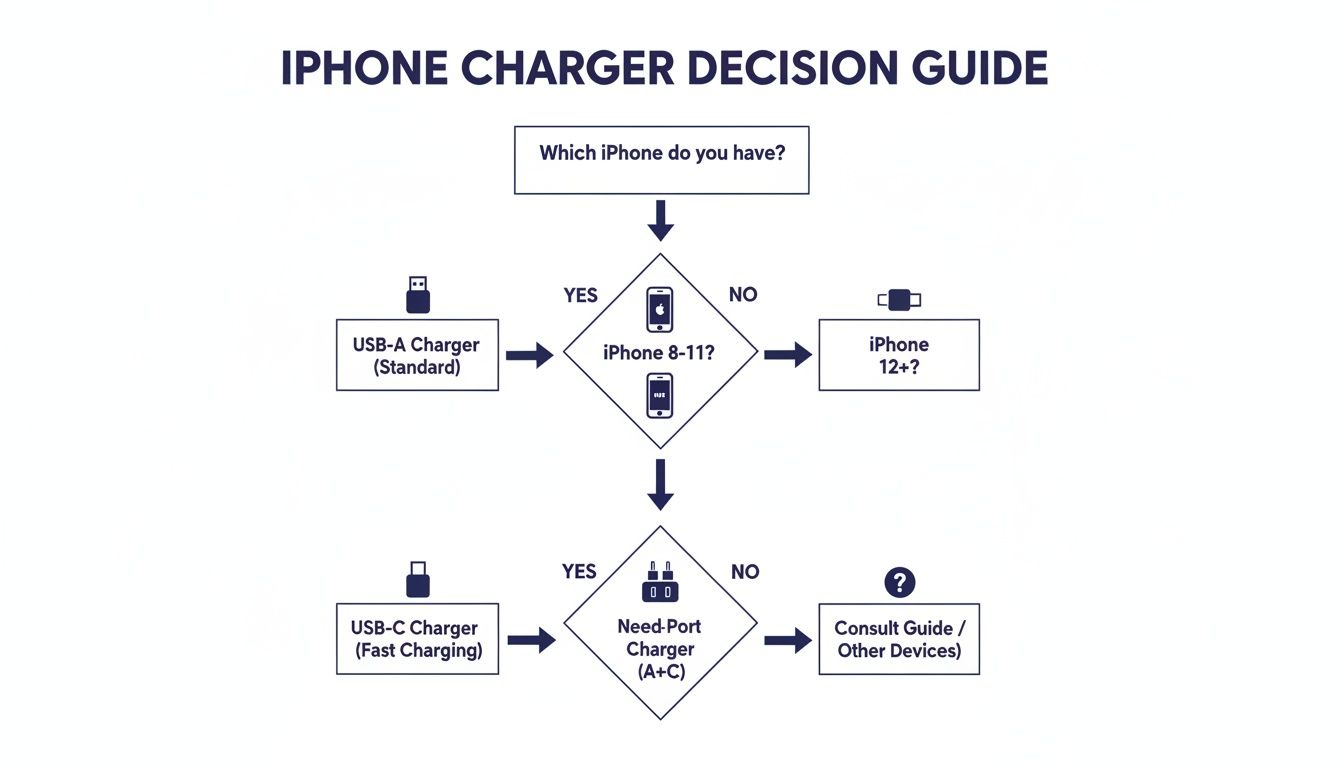 alt text: A flowchart guiding users to choose the right iPhone car charger based on their phone model.
Isolating The Faulty Component
Now we need to play detective and figure out if the problem is your charger or your car.
-
Test the Charger: Plug your car charger and cable into a friend's car. If your iPhone starts charging, the charger and cable are fine. The issue is likely your car's power socket.
-
Test the Power Socket: Find another device that plugs into the car's socket, like a dashcam or another charger. If that device doesn't power up, you've confirmed the socket is the problem. This could be as simple as a blown fuse. If you suspect a fuse or wiring problem, it’s worth learning how to diagnose car electrical problems.
When The iPhone Itself Is The Problem
So, you've run through all these steps. Other devices charge fine in your car, but your iPhone still refuses to cooperate. At this point, the problem is likely isolated to your iPhone's charging port. Even if the port looks clean, the tiny internal pins can get damaged. For a deeper dive, check out our guide on what to do when your phone is not charging. For the experienced DIYer, replacing the charging port is a manageable job. For most people, though, bringing it to a professional is the safest bet.
Your Partner in iPhone Power and Performance
Choosing a top-quality, certified charger is fundamental to protecting your iPhone. We’ve walked through the lightning-fast speeds of USB-C PD, the click-and-go magic of MagSafe, and why MFi certification is an absolute non-negotiable for safety. But having a local Aussie expert you can trust for quality parts and solid advice makes all the difference.
More Than Just a Repair Shop
Here at Screen Fixed, we're your dedicated partner in keeping your devices in peak condition. Our mission is to give professional repair shops and keen DIYers the tools and components they need to get the job done right. That’s why we've also put together a hand-picked range of premium charging accessories that meet our own tough standards.
Premium Parts for Professionals and DIYers
We're a leading supplier of OEM-quality replacement parts—like charging ports and batteries—for repair shops all over the country. And for the DIYers out there? We offer those very same professional-grade components. This means you can pull off a lasting, high-quality fix without cutting corners.
Think of Screen Fixed as your one-stop resource for both power and performance. We're here to bridge the gap, whether you just need a new top-tier accessory or you're facing a full-blown repair.
With our total commitment to quality, same-day dispatch on orders placed before 3pm AEST, and local support from our hubs in Brisbane, Sydney, and Melbourne, you're completely covered. Whether you're upgrading your charger car iPhone setup or need an expert to step in, you can count on us.
Ready to power up your iPhone the right way or need a fast, reliable fix? Book your repair with Screen Fixed Brisbane today.
Disclaimer: Screen Fixed is an independent repair service and is not affiliated with Apple Inc. All third-party brand names and logos, including Apple, iPhone, and MagSafe, are the property of their respective owners and are used for identification purposes only.
Your Questions Answered
When it comes to iPhone car chargers, a few common questions pop up. To help you get the right gear, we’ve put together answers to some of the queries we hear most often from Aussie drivers.
What’s the Absolute Fastest Way to Charge My iPhone in the Car?
Without a doubt, the quickest way to juice up any modern iPhone (iPhone 8 or newer) is with a USB-C Power Delivery (PD) charger. If you really want to see the battery percentage climb, especially on an iPhone 12 or later, grab a charger that can pump out at least 20W of power. This setup is the gold standard for speed, giving you a serious boost—often up to 50% in around 30 minutes.
Will a High-Wattage Charger Fry My Older iPhone?
It’s a common worry, but the answer is no. A powerful charger won't harm an older device. Your iPhone has smart charging tech that tells the charger exactly how much power it needs. When you plug an older iPhone into a 20W charger, the phone simply draws the maximum power it can safely handle. A higher-wattage charger is a great, future-proof investment that’s perfectly safe for your current gear.
The key thing to remember is that your iPhone, not the charger, is in control of the charging speed. This intelligent system is designed to protect your device's battery and internal components.
Is a MagSafe Car Charger a Good Idea?
For anyone with an iPhone 12 or newer, a MagSafe car charger is a brilliant bit of kit, mainly for convenience. While it charges a little slower (up to 15W) than a USB-C cable, the magnetic snap-on system is incredibly secure and easy to use while you're focused on the road. No more fumbling with cables or worrying about a worn-out charging port. It’s a fantastic option for daily top-ups.
If you've tried everything and your phone still won't charge properly, the issue might be the charging port itself. When that happens, let the experts take a look. At Screen Fixed, we offer professional diagnostics and repairs to get your devices back in top shape. For reliable iPhone repairs in Brisbane, book your service with Fixo today.