

Meta Title: Tempered Glass Screen Protector Guide | Screen Fixed Brisbane
Meta Description: Learn why a tempered glass screen protector is vital for your phone. Our guide covers installation, care, and how to choose the right one in Australia.
A tempered glass screen protector is a seriously tough sheet of specially treated glass, custom-cut to shield your phone's display from all sorts of daily abuse—think scratches, impacts, and the dreaded corner crack. It's not just another accessory; it's the best insurance policy you can buy for your device's most fragile and expensive part.
Why Your Smartphone Screen Needs a Protector
We’ve all felt that heart-stopping moment when our phone slips from our grasp. Staring down at a spiderweb of cracks is a universal feeling of dread. Our phones are central to everything we do, and a damaged screen isn't just an eyesore—it's a costly, inconvenient disaster waiting to happen.
Sure, modern phone screens are tougher than they've ever been, but they are a long way from indestructible.
Even with fancy names like Gorilla Glass, it’s the microscopic scratches from daily life that do the real damage over time. Grains of sand in your pocket, keys in your bag, or just sliding it across a table—all these tiny abrasions create invisible weak points. A small drop that your phone might have shrugged off on day one could cause a complete shatter months later. This is exactly where a tempered glass screen protector proves its worth.
The Simple Economics of Protection
When you weigh the cost, it’s a no-brainer. For a tiny fraction of what you'd pay for a screen replacement, a quality protector takes all the hits. It's a sacrificial layer, engineered to absorb shocks and deflect scratches, so your actual screen doesn't have to.
The global market for tempered glass is massive for a reason—it was valued at around USD 50.3 billion in 2022 and is only climbing. For anyone in Australia with an iPhone or a high-end Android, a single screen replacement can set you back hundreds of dollars. In stark contrast, a premium screen protector is a small, one-time investment for a whole lot of peace of mind.
A screen protector is the most basic, yet most effective, way to preserve your device's value and functionality. It acts as the first line of defence, absorbing the wear and tear that would otherwise degrade your phone's pristine display.
More Than Just Scratch Resistance
While stopping scratches is its main job, a tempered glass screen protector does so much more. It helps maintain your phone’s resale value, keeps the display's clarity crystal clear, and ensures that smooth, responsive touch experience you paid for. If you want to dive deeper, you can learn more about why you should buy a screen protector in our detailed guide.
Ultimately, this thin piece of glass is your best defence against the hazards of everyday life. It’s a simple solution to a very expensive problem, keeping your digital lifeline safe, functional, and looking brand new.
The Science Behind a Tempered Glass Shield
Ever wondered how a sliver of glass, often less than half a millimetre thick, can take the hit for your pricey phone screen during a nasty fall? It’s not magic—it's some seriously clever engineering. A tempered glass screen protector is more than just a sheet of glass; it's a sophisticated, multi-layered shield built to absorb and spread out impact forces.
Understanding this layered construction is key to seeing why it’s such an effective guard for your device. Each layer has a distinct job, and they all work in concert to protect against scratches, shatters, and even those annoying smudgy fingerprints. Let's peel back the layers and see what makes this little guardian tick, starting from the bottom up.
The Foundation: A Silicone Adhesive Layer
The whole process starts with the part that actually sits on your screen: a layer of high-quality silicone adhesive. This is way more advanced than simple sticky tape. It's engineered to do two critical things. First, it ensures a smooth, bubble-free fit by creating a solid, even bond with your phone's display. This connection is crucial for maintaining perfect touch sensitivity, so every tap and swipe feels just right.
Even more importantly, this silicone layer is your first line of shock absorption. When your phone hits the deck, that impact energy has to go somewhere. The silicone’s slightly flexible nature helps cushion the blow, spreading the force across the protector's surface instead of letting it zero in on one spot on your screen. Think of it like the crumple zone on a car, designed to take the damage so the important stuff stays safe.
This simple diagram perfectly captures the economics of protection: a small outlay on a protector can save you from a much bigger bill for a screen repair.
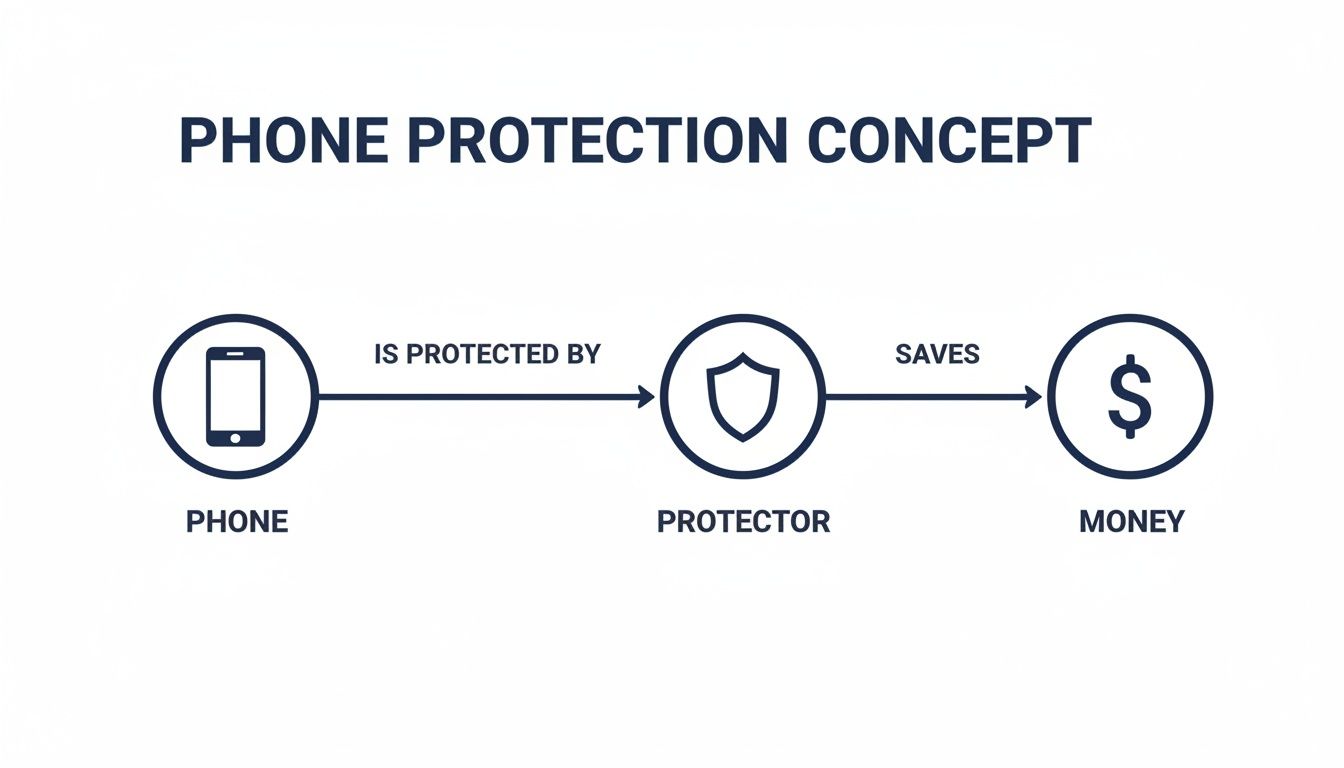
A tempered glass screen protector is a small investment to prevent costly screen damage.
As you can see, the protector acts as a sacrificial shield between your phone and potential damage, which directly translates into money saved.
The Safety Net: A PET Film Layer
Sitting right on top of the adhesive is a thin layer of PET (Polyethylene Terephthalate) film. You've seen this durable plastic before in drink bottles and packaging, but here it plays a vital safety role. If your tempered glass protector does shatter from a really hard impact, this film is what holds all the tiny, sharp glass pieces together.
This anti-shatter feature is what stops the protector from exploding into dangerous shards that could scratch the screen underneath or, worse, cut your fingers. It keeps all the broken bits contained, making it safe and straightforward to peel off the damaged protector in a single piece.
The Core: The Tempered Glass Itself
This is the heart and soul of the protector, and it’s where the real muscle comes from. To make it, regular glass goes through an intense process of extreme heating followed by rapid cooling. This thermal treatment, known as tempering, completely changes the glass's molecular structure.
The process forces the outer surfaces into a state of high compression while the core remains in tension. This internal stress is what makes the glass roughly four to five times stronger than standard, untempered glass of the same thickness. It’s this engineered strength that lets it shrug off major impacts and resist deep scratches from everyday hazards.
A question we hear all the time at our Screen Fixed Brisbane shop is about the "9H Hardness" rating. This is a reference to the Mohs scale of mineral hardness, where 9H is on par with materials like topaz. In the real world, this means your protector can easily fend off scratches from keys, coins, and even a knife. But it's still vulnerable to harder materials like sand (which is mostly quartz), and that's why a trip to the beach can still spell trouble for an unprotected screen.
The Finishing Touch: An Oleophobic Coating
The final layer, the one your finger actually touches, is an oleophobic coating. The name might sound technical, but its job is simple: "oleo" means oil, and "phobic" means to repel. This microscopically thin layer is essentially an oil-repellent surface designed to fight off fingerprints, smudges, and makeup.
It's what gives the tempered glass that smooth, slick feel, just like your phone's original display. More importantly, it makes the screen a breeze to wipe clean, keeping your view crystal clear. While this coating can wear down over many months of use, it’s a key feature that separates quality protectors from the cheap knock-offs, preserving both the look and feel of your device.
How to Choose the Right Screen Protector
Let's be honest, not all tempered glass screen protectors are made the same. With a dizzying number of options out there, trying to pick the right one can feel like a shot in the dark. But it doesn’t have to be.
Finding the perfect shield for your device really just boils down to understanding a few key differences in their design and what they're built to do. Knowing what to look for means you get the protection you need without sacrificing the look or feel of your phone.
Understanding the Main Types
The first decision you'll likely face is about the protector's cut and how much of the screen it covers. Different designs are suited for different phones and, just as importantly, different phone cases.
Here’s a quick rundown of the most common styles you'll come across:
- Standard 2.5D Protectors: Think of these as the reliable workhorse. They are flat protectors with slightly rounded edges that cover the entire flat, touch-sensitive part of your screen but stop just before the edges start to curve. This gap is intentional and makes them highly case-friendly, giving plenty of room for a case to wrap around the phone without lifting the protector's corners.
- Edge-to-Edge 3D/Curved Protectors: If you’ve got a phone with a curved display (like many of the Samsung Galaxy models), these are for you. They’re moulded to match the screen’s curves perfectly, offering more complete coverage. The only catch is they can sometimes clash with bulky or tight-fitting cases.
- Privacy Protectors: These are an absolute game-changer for anyone who uses their phone on public transport or in crowded cafes. A special filter narrows the viewing angle so only you, looking straight at the screen, can see what’s on it. To anyone peeking from the side, the screen just looks black.
- Matte or Anti-Glare Protectors: If you’re constantly squinting at your screen outdoors or under bright office lights, a matte protector is your new best friend. Its surface is etched to diffuse harsh reflections, cutting down glare significantly. It’s also brilliant at hiding fingerprints, though it can ever so slightly soften the screen’s sharpness.
Often, there’s a trade-off. A 3D curved protector gives you that full, seamless coverage, but a 2.5D protector might be the smarter choice if you like swapping between chunky, protective phone cases.
Critical Factors to Consider
Beyond the basic style, a few small details separate a great screen protector from a genuinely frustrating one. Get these right, and you'll forget it's even there.
First up, case compatibility. This is non-negotiable. A protector that constantly lifts at the edges because your case is pushing on it isn't just annoying—it’s also not protecting your phone properly. Always look for protectors labelled "case-friendly," especially if you use a rugged, full-coverage case.
Next, check for precise cutouts. Your phone is loaded with sensors—for proximity, ambient light, and of course, the front-facing camera. They all need a clear, unobstructed line of sight to work as intended. A poorly designed protector can block them, messing with everything from Face ID to automatic brightness and even whether your screen turns off during a call.
If you're weighing up your options, it's worth knowing how tempered glass stacks up against other materials. To get the full picture, check out our detailed comparison of hydrogel screen protectors vs tempered glass.
Notes for Repair Shops and Wholesale Buyers
For any business offering iPhone repairs in Brisbane or anywhere else in Australia, locking in a dependable supplier is everything. Your customers rely on you for quality parts, and screen protectors are a massive part of that trust. Keeping consistent stock of protectors for popular models is crucial to meeting demand without making people wait.
A good wholesale partner also gets the bigger picture. In Australia, pairing quality refurbished screens with a durable tempered glass protector is a perfect fit for the growing push towards sustainability in electronics. The Asia-Pacific region, including Australia, led the glass screen protector market in 2023, and this growth is tracked as its own distinct market—that’s how important it is.
Sourcing from a supplier who guarantees quality helps you support this trend and, more importantly, keeps your customers happy and avoids frustrating return visits.
Nailing a Flawless Installation at Home
Unboxing a brand new tempered glass screen protector is the easy part. Getting a perfect, bubble-free installation? That can feel like a high-stakes operation. But here’s the thing: a flawless application isn’t about luck; it’s about having a solid process. With the right preparation and a steady hand, anyone can get a result that looks like it was done by a pro.
This guide breaks it all down into simple, manageable stages. From setting up the ideal environment to handling those last-minute hiccups, these steps will help you get it right the first time.
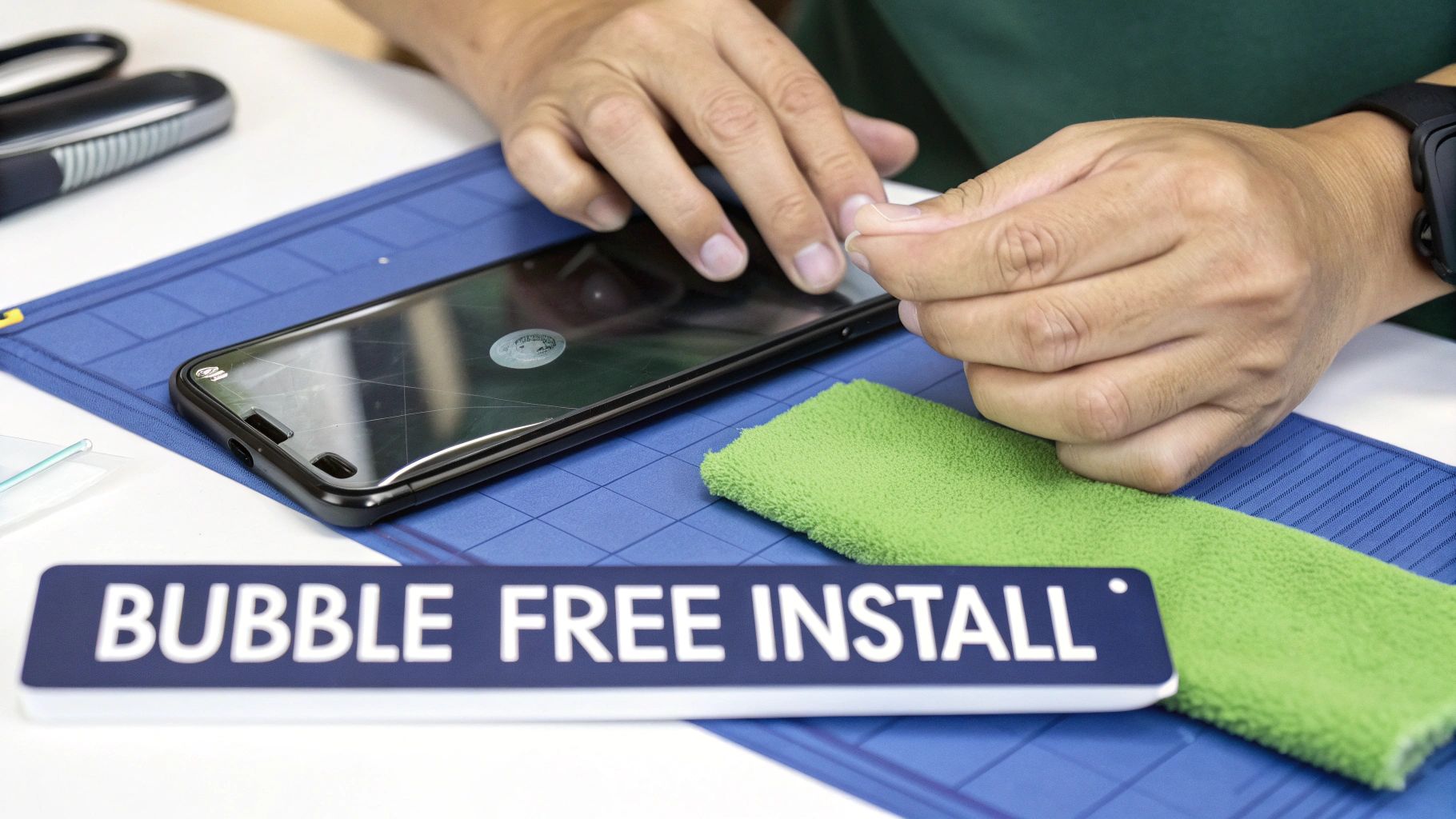
Careful alignment is key to a perfect tempered glass screen protector installation.
Stage 1: Prep Your Workspace
The number one enemy of a clean installation is airborne dust. Seriously, even a single tiny speck trapped under the glass creates an annoying, permanent bubble. The trick is to control your environment before you even open the package.
Here’s a great pro tip: try working in a bathroom after running a hot shower for a few minutes. The steam actually helps pull dust particles out of the air, creating a much cleaner workspace.
Before you start, make sure you have:
- A flat, well-lit surface to work on.
- Clean hands. Wash and dry them thoroughly to get rid of any oils.
- All the items from your protector kit laid out: the glass, alcohol wipe, microfibre cloth, and dust removal sticker.
Stage 2: Clean the Screen Like You Mean It
This is the most critical stage, so don't rush it. Your phone's screen must be completely free of any smudges, oils, or dust for the adhesive to bond perfectly.
Start by powering off your device. The black screen makes it way easier to spot any imperfections. Use the included alcohol wipe to thoroughly clean the entire surface, paying extra attention to the edges where grime tends to build up. Immediately follow up with the microfibre cloth, buffing the screen until it’s completely dry and streak-free.
For the final, crucial step, grab the dust removal sticker. Lightly dab it across the entire screen to pick up any remaining microscopic lint or dust particles that have settled. Hold the phone at an angle under a light to give it one last check before moving on.
Stage 3: Align and Apply with Precision
With a perfectly clean screen, it's time for the main event. Most modern kits come with an alignment frame that just clips onto your phone, making this step almost foolproof. If yours doesn't have one, you'll want to use the 'hinge method'.
The Hinge Method for Perfect Alignment
Place the protector on the screen (with the backing still on) and get it lined up just right. Use two pieces of tape to secure one side of the protector to the phone, creating a 'hinge'. This lets you flip the protector back, peel off the adhesive backing, and then flip it back down into the exact same spot without any guesswork.
Once you’re ready, peel the protective film from the adhesive side of the glass, holding it carefully by the edges. Gently lower it onto your phone's screen. Don't press down just yet; let the adhesive start to spread on its own from the centre outwards.
Stage 4: Final Touches and Troubleshooting
After the protector is in place, press down gently in the centre and watch as the adhesive spreads to the edges, pushing out most of the air. Use the microfibre cloth to firmly smooth out any remaining large air bubbles, always pushing from the centre towards the outer edges.
What if you spot a stray dust speck? Don't panic. You can carefully lift one corner of the protector with a fingernail, slide the dust removal sticker underneath to grab the particle, and then slowly lower the glass back down. For more complex installations, like those involving UV glue, you can find great advice in our tutorial on how to install a NuGlas UV glue screen protector.
Any small bubbles that are still there might just disappear on their own over the next 24-48 hours as the adhesive fully cures. By following these steps, you'll have your device perfectly protected in no time.
Knowing When to Replace Your Screen Protector
A tempered glass screen protector has one job: to take a hit so your phone's actual screen doesn't. Think of it as a sacrificial shield. But once it's taken a few knocks, how do you know its tour of duty is over and it's time for a new one?
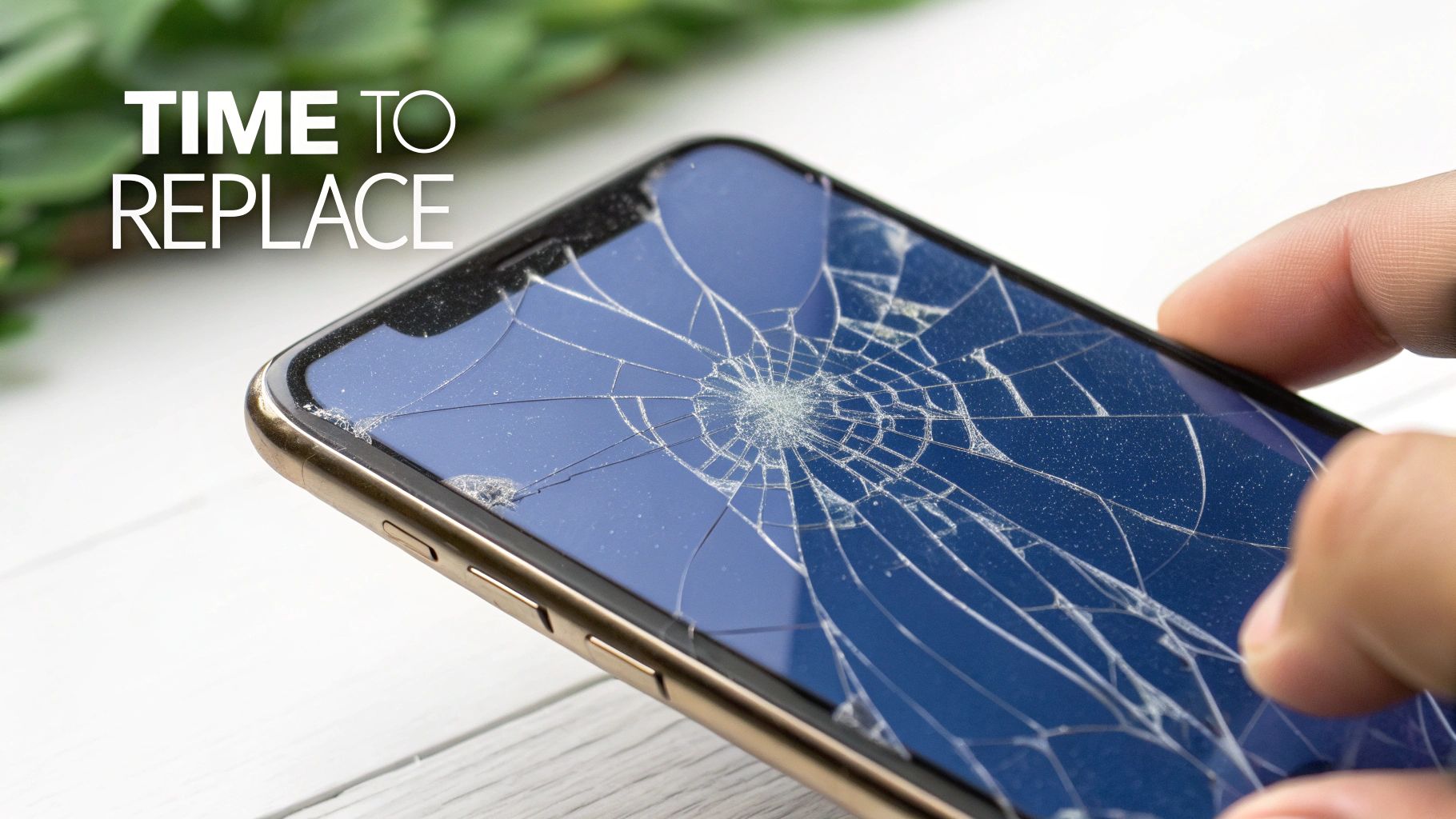
A cracked protector, like on this iPhone 14 Pro, means it's time for a replacement.
Ignoring a busted protector is a classic mistake. A damaged shield doesn't just look awful; it's lost its ability to properly absorb the next impact. Suddenly, your expensive display is left wide open and vulnerable. Spotting the warning signs is the key to keeping your device safe.
Clear Signs It’s Time for a Change
Knowing what to look for can save you from a gut-wrenching, costly screen repair down the line. If your protector is showing any of these signs, it's time to swap it out.
-
Deep Cracks or Spiderwebbing: This one's the most obvious red flag. A single deep crack shatters the structural integrity of the entire piece of glass. It’s a lot like a crack in a car windscreen; one small bump can make it spread in an instant. Spiderwebbing means the protector has already taken a massive hit and can no longer distribute force evenly.
-
Significant Chips Along the Edges: The edges and corners are always the weak spots on a phone. If your protector has noticeable chips, it’s creating a new weak point. The next time the phone drops, the impact is far more likely to sneak past the damaged protector and go straight for your screen.
-
Lifting or Peeling Corners: When the edges of your protector start peeling away from the screen, you've got a problem. This gap lets dust, dirt, and moisture creep underneath, which can lead to ugly air bubbles and even scratch the display itself. A bad seal also makes it much less effective at absorbing shock.
-
Loads of Scratches: A tempered glass protector is tough against scratches, but it’s not invincible. Over time, a build-up of deep scratches can make the display hard to see and physically weakens the glass, making it more likely to shatter from a pretty minor drop.
Extending the Lifespan of Your Protector
While you'll eventually have to replace it, a little bit of care can go a long way in prolonging your screen protector's life. Good maintenance not only keeps your screen looking sharp but helps you spot any new damage early on.
A question we get all the time at our Screen Fixed Brisbane repair shop is about the best way to look after a screen protector. The answer is simple: treat it just like you would the original screen. Regular, gentle cleaning makes a massive difference.
Just use a soft, microfibre cloth to wipe away fingerprints and smudges. Stay away from harsh chemicals or abrasive materials, as they can strip away the oleophobic coating that helps repel oils. A clean protector means you always have a clear view of your screen and can spot any new cracks or chips the moment they appear, signalling it's time for a change.
At the end of the day, a screen protector is a consumable item. Its whole purpose is to break so your phone doesn't. When it starts showing signs of wear and tear, replacing it is a small, cheap step that brings back your phone's best line of defence against a much more expensive accident.
Frequently Asked Questions
When you're dealing with tempered glass screen protectors day in and day out, you start to hear the same questions pop up. It makes sense—you want to be sure you're making the right call for your device. Here are a few of the most common queries we get from customers in our repair shops.
Will It Affect Touch Sensitivity or Face ID?
Not if you’ve got a good one. A quality tempered glass screen protector is so thin—usually between 0.3mm and 0.5mm—that you'll barely notice it's there. It's designed to feel just like your phone’s original screen.
Modern protectors are also built to play nice with all the fancy tech in today's phones, like Apple's Face ID and those slick in-display fingerprint sensors. At Screen Fixed, we only stock protectors that have been rigorously tested to make sure they don't mess with touch response or biometrics. The goal is a seamless experience, every time.
What Does a 9H Hardness Rating Actually Mean?
You'll see "9H" plastered on just about every screen protector package, and it's a reference to the Mohs scale of mineral hardness. In simple terms, a 9H rating means the glass is as hard as minerals like sapphire.
Why does this matter? It means the surface can stand up to scratches from everyday hazards like keys and coins rattling around in your pocket. Think of it as a key indicator of the protector's toughness and its ability to keep your actual screen looking brand new.
Just remember, while a 9H protector is tough, it’s not invincible. Its main job is to take the hit and sacrifice itself, so your much more expensive phone screen doesn't have to.
Can I Reuse a Screen Protector After Removing It?
That's a definite no. The special adhesive used on tempered glass is engineered for one single, perfect application to get that bubble-free seal.
Once you peel it off, the adhesive is done for. It immediately starts picking up dust and lint from the air, making it impossible to reapply without trapping bubbles and imperfections. You'll end up with a poor fit, blurry screen, and much weaker protection, which completely defeats the purpose of having one in the first place.
Whether you need a new screen protector fitted or require a full screen replacement, our team has you covered. Book your repair with Screen Fixed Brisbane today for expert service you can trust.
Disclaimer: All third-party trademarks (including logos and icons) referenced by Screen Fixed remain the property of their respective owners. Unless specifically identified as such, Screen Fixed’s use of third-party trademarks does not indicate any relationship, sponsorship, or endorsement between Screen Fixed and the owners of these trademarks.