

A new iPhone battery in Australia usually means A$109 to A$149 through Apple, depending on the model and service path. Third-party repair and DIY can be materially cheaper, which is why the smartest option often comes down to how much you value warranty, convenience, and control over the parts used.
If your iPhone is dying by mid-afternoon, shutting down under load, or just feeling tired, battery replacement is often the first repair worth considering. In the workshop, this is one of the few jobs that can still make an older phone feel properly usable again without stepping up to the cost of a full device replacement.
For Australian users, the main question usually isn't just how much is a new iPhone battery. It's whether you should pay Apple's fixed benchmark, use an independent repairer, or buy a quality replacement battery and do the job yourself. Each path has a clear trade-off, and some make a lot more sense than others depending on the phone, your confidence level, and whether the handset still has broader value.
Table of Contents
- Apple's Official iPhone Battery Replacement Costs in Australia
- How to Know If Your iPhone Needs a New Battery
- The Cost of Third-Party and DIY Battery Replacements
- Comparing Your Repair Options Side-by-Side
- Which Battery Replacement Path Is Right for You
- Your Next Steps for a Longer-Lasting iPhone
Apple's Official iPhone Battery Replacement Costs in Australia
You notice your iPhone battery dropping hard by mid-afternoon, and the first question is usually simple. What will Apple charge to fix it in Australia?
Apple is still the price benchmark because it publishes battery service pricing by model. For Australian customers, older iPhones generally sit at the lower end, newer standard models cost more, and current Pro or flagship models are usually at the top of the range. Apple's current battery service pricing is listed on its official iPhone battery replacement page.
From a repair shop point of view, Apple's fee is not just the cost of the battery itself. You are paying for the full service process, including assessment, labour, fitting, and final testing. That matters because a DIY battery listing from a local parts supplier is only one part of the total job.
What you're paying for with Apple
Apple's pricing makes sense for people who want the least guesswork.
In practical terms, the price usually covers:
- The battery and installation
- Device checks before and after the repair
- A standardised service process
- A straightforward option for owners who do not want to source tools or parts themselves
That convenience has a cost. In my experience, Apple is usually the safest hands-off choice, but not always the best value if the phone is older and you are trying to keep spending sensible.
When AppleCare+ changes the maths
Apple's official route becomes much easier to justify if the phone has AppleCare+ and the battery qualifies for service under that cover. In that case, the out-of-pocket cost can drop sharply or disappear, depending on eligibility under Apple's terms.
For everyone else, Apple sets the premium baseline. That is the number to compare against an independent repairer or a DIY job using quality local parts. If you want a broader Australian breakdown before choosing, this guide to iPhone battery replacement in Australia is a useful reference.
The trade-off is straightforward. Apple gives you the most controlled service path. DIY usually cuts the parts cost, especially if you buy from an Australian supplier and already have the tools or are happy doing careful repair work yourself. Independent shops sit in the middle.
How to Know If Your iPhone Needs a New Battery
Battery replacement only makes sense if the battery is the problem. A lot of people blame the battery when the underlying issue is heavy background usage, poor signal, a hot environment, or a charging fault.
Still, worn batteries do follow a pattern, and iPhones give you a decent built-in way to check.
What battery wear actually looks like
A battery that's reached the end of its useful life doesn't just run flat faster. It also struggles to deliver stable power when the phone is under load.
Common signs include:
- Shorter runtime where the phone no longer gets through your normal day
- Unexpected shutdowns even when the battery indicator doesn't look critically low
- Slowdowns under strain because the phone may limit performance when the battery can't keep up
- More sensitivity to heat or cold which can make the device feel inconsistent from one day to the next
Apple says iPhone batteries are designed to retain up to 80% of original capacity after 500 complete charge cycles, and replacement usually makes sense when daily use is being affected, not just when you're fixated on a single number (Apple battery lifecycle guidance quoted here).
A battery health reading is useful, but the real test is whether the phone still meets your day-to-day workload.
If your battery is draining quickly and you want to rule out software and usage causes before opening the phone, this guide on why an iPhone battery is draining fast is a sensible first check.
How to check battery health properly
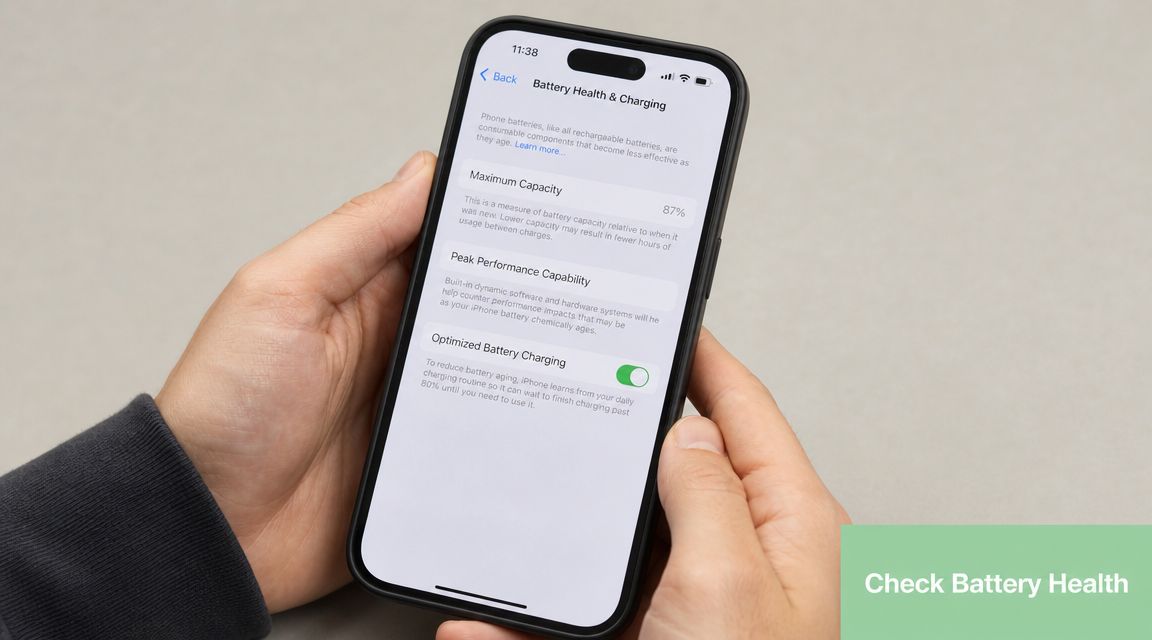
On supported iPhones, go to Settings > Battery > Battery Health & Charging. The main thing to look at is Maximum Capacity.
That figure tells you how much charge the battery can hold relative to when it was new. It doesn't tell the whole story, but it gives you a solid starting point.
A practical way to read it:
- If the phone still lasts all day, you probably don't need to rush.
- If the number has dropped and your usage is affected, replacement starts to make sense.
- If you see runtime loss plus shutdowns or lag, the battery is a very likely culprit.
- If the phone is otherwise fine, battery replacement is usually the highest-value repair.
The video below walks through what that menu looks like and how people typically interpret it.
In real use, I tell people not to get stuck on the percentage alone. A commuter who streams, uses maps, and runs mobile data all day will feel battery wear sooner than someone who mostly messages and takes calls. The battery has to fit the job.
The Cost of Third-Party and DIY Battery Replacements
Once you've got Apple's benchmark in mind, the alternative paths start to make more sense. Here, cost drops, but variation goes up.
Independent repairers and DIY buyers don't all use the same parts, don't all follow the same process, and don't all deliver the same result. That's the upside and the risk.
Why Apple sets the benchmark
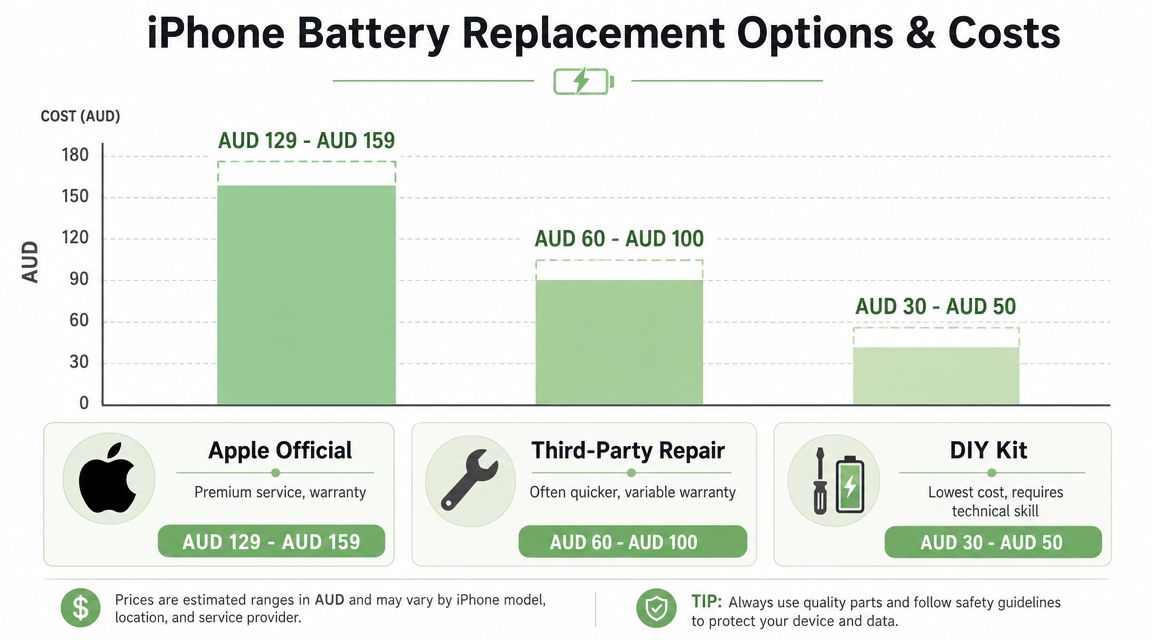
Independent iFixit guidance notes that iPhone battery replacement kits average around US$40, with newer-model kits around US$55, and that DIY replacement can save around US$34 to US$49 versus Apple's out-of-warranty repair pricing (Apple support discussion referencing iFixit kit pricing). Those are global figures, not Australian shelf prices, but they explain why many owners see Apple as the premium convenience option rather than the lowest-cost option.
That tracks with what repairers see every day. A battery job is usually less expensive and less risky than major structural repairs like back glass or frame work, but quality still matters. Cheap cells can fit poorly, report badly, or age faster than expected. The difference often isn't obvious on day one. It shows up later in charge stability, heat, swelling risk, and consistency.
What DIY really costs
DIY can be the cheapest path if you already have steady hands, patience, and the right tools. If you don't, the job can become expensive quickly because one torn flex cable or one damaged display turns a battery repair into a larger repair.
For a sensible DIY setup, think in terms of three categories:
- Battery quality. Buy a replacement matched to your exact iPhone model, not just a generic listing with broad compatibility claims.
- Tools. You need proper opening tools, drivers, adhesive handling gear, and a safe work surface. If you're starting from scratch, a dedicated iPhone repair tool set is more realistic than improvising with household screwdrivers.
- Adhesive and sealing. A lot of failed DIY jobs aren't battery failures. They're reassembly failures. The phone goes back together badly, the screen sits proud, or dust and moisture protection are compromised.
For readers who want a walkthrough before deciding, this step-by-step guide on how to replace an iPhone battery is useful because it shows the process, not just the parts list.
I also see a practical split between two types of DIY buyer:
- The careful home fixer who wants one battery and maybe a pre-matched kit
- The trade buyer or repeat repairer who cares more about part consistency, stock availability, and tool compatibility
Fixo fits into that second conversation as well as the first. It's a local supplier of iPhone batteries, tools, and DIY kits for Australian repairers and home users. That's useful if you want local stock rather than piecing a job together from mixed overseas sellers.
DIY works well when the phone is still worth keeping, the screen is already in good condition, and you're happy trading convenience for lower parts cost.
What doesn't work is chasing the absolute cheapest battery listing you can find and expecting the result to match a proper service path. With batteries, low price alone isn't a quality signal.
Comparing Your Repair Options Side-by-Side
The easiest way to decide is to stop thinking in slogans like "official is safer" or "DIY is cheaper" and compare the actual trade-offs. Cost matters, but so do turnaround, part source, repair skill, and what happens if something goes wrong.
iPhone Battery Replacement Options in Australia
| Factor | Apple Authorized Service | Independent Repair Shop | DIY with Fixo Parts |
|---|---|---|---|
| Estimated cost | Official Australian benchmark pricing sits around A$109 to A$149 depending on model and service path | Usually below Apple's official service benchmark, but varies by shop, part grade, and labour | Usually the lowest direct parts cost, plus tools if you don't already own them |
| Repair time and convenience | High convenience if you want a formal service process, but you may need booking or shipping | Often faster and more flexible for walk-in local work | Slowest for a first-timer because you do diagnosis, opening, replacement, and reassembly yourself |
| Part quality and source | Apple-managed service pathway and component supply | Depends entirely on the shop and the battery grade they choose | You choose the battery grade and the tool quality yourself |
| Skill required from you | None beyond booking the repair | None beyond choosing a reputable repairer | Moderate to high. You need care, patience, and the right tools |
| Diagnostics and verification | Included as part of the official service pathway | Varies by shop | You handle your own checks before and after installation |
| Warranty considerations | Best fit for people who want the official route | Depends on the shop's terms and your phone's existing status | You carry the installation risk yourself, and non-Apple repair may affect remaining warranty situations |
| Best for | Owners who want certainty, minimal involvement, or AppleCare+ eligibility | People who want a hands-off repair without paying the official premium | Budget-conscious users and technicians who want maximum control |
A table like this usually clarifies the decision quickly. If you don't want to touch the phone, DIY isn't cheaper in any meaningful sense. If you already repair devices or are comfortable following a guide carefully, Apple's premium starts to look like a convenience fee rather than a necessity.
The cheapest successful repair is the one that doesn't create a second repair.
Independent shops sit in the middle for a reason. They remove the installation risk from you, but they don't lock you into the official service pathway. That can be the sweet spot for people who want lower cost than Apple without learning battery adhesive removal and screen opening technique themselves.
Which Battery Replacement Path Is Right for You
The Australian repair market has become more interesting because repair is no longer treated as a fringe option. Recent Australian government movement around product stewardship and repairability has pushed more attention toward whether repair should be easier and cheaper, while Apple's official battery pricing still acts as the fixed benchmark and third-party or DIY paths offer lower parts-only alternatives (Australian repairability context and local repair economy discussion).
That gives you a real choice. Not every phone owner should make the same one.
Choose Apple if certainty matters most
Apple makes the most sense when:
- Your phone may qualify under AppleCare+
- You want the least decision-making
- You don't want to judge battery grades or repair quality yourself
- You'd rather pay a fixed official benchmark than compare suppliers
This is also the path I'd recommend for users who hate any uncertainty around repair. If peace of mind is the priority, paying more can be rational.
Choose an independent shop if you want a hands-off middle ground
This path suits people who want someone else to do the work, but don't want to pay the official benchmark if they don't have to.
A good independent repairer is worth using when:
- The phone is out of warranty
- You want quick local turnaround
- You care about value, but not enough to do the repair yourself
- You can ask sensible questions about the battery being installed
Ask what battery grade they're using, what testing they do after the job, and how they handle a problem if the device shows new symptoms after repair. A serious shop will answer plainly.
Choose DIY if you want the lowest parts cost and full control
DIY is the strongest option for people who are comfortable opening electronics and following a precise process. It's also attractive if you want to choose the replacement part yourself instead of outsourcing that choice to a shop.
DIY makes sense if:
- The phone still suits your needs, so extending its life is worthwhile.
- You're comfortable with small screws, adhesive, and delicate connectors.
- You accept the installation risk if something goes wrong.
- You want to keep repair costs focused on parts and tools rather than labour.
Safety matters here. Lithium-ion batteries aren't forgiving if they're punctured, bent aggressively, or overheated during removal. Work slowly, use the correct tools, and don't force anything. If the adhesive fights back, patience is safer than force.
The other thing to be honest about is warranty status. If the phone still has any remaining manufacturer support, non-Apple repair may complicate that situation. For an older out-of-warranty iPhone, that trade-off is usually much easier to accept.
Your Next Steps for a Longer-Lasting iPhone
Your iPhone starts dying at 30 percent on the train home, then struggles to last a full workday. At that point, the main question is not just how much a new iPhone battery costs in Australia. It is whether the phone is worth keeping, and which repair path gives you the best return for the money.
Use Apple as the price reference, as noted earlier in this guide. Then compare that with what a local repair shop will charge, or what it costs to buy a quality battery and tools yourself. In Australia, the gap between those options can be large enough to matter, especially on an older phone that still does everything you need.
The smart next step is simple. Match the repair option to the phone's value, your risk tolerance, and how hands-on you want to be.
If the iPhone is newer, still in strong condition, or you want the official service path, paying Apple can make sense. If you want someone else to handle it for less, a good independent shop is often the middle ground. If the phone is out of warranty and you're comfortable doing careful work, DIY usually gives you the lowest total cost and the most control over the part that goes into the device.
A battery replacement can still be money well spent. I've seen plenty of iPhones get another year or two of useful life from a fresh battery, provided the screen, charging port, and board are otherwise healthy.
Before you spend anything, check the exact iPhone model, confirm the battery symptoms, and decide whether you want convenience or savings. That decision usually saves more frustration than chasing the absolute cheapest option.
If you're ready to repair instead of replace, Fixo stocks iPhone batteries, DIY repair kits, and repair tools for Australian technicians and home users who want a straightforward parts source with local availability.