

A customer is standing at the counter with a cracked iPhone screen, or your own Samsung is open on the bench with screws lined up beside it. The repair itself might only take a short time. The risk sits in the part you install.
If the display has poor colour, the frame doesn't sit flush, Face ID or fingerprint functions become unreliable, or the battery health drops fast after a few charge cycles, the customer won't blame the supply chain. They'll blame the shop. That's why choosing cell phone parts suppliers isn't just a buying task. It's one of the biggest quality-control decisions in the whole repair process.
In Australia, that decision has extra weight because speed matters almost as much as quality. A shop in Brisbane, Sydney, Perth, or regional NSW can lose a full day waiting on the wrong part, and one bad batch can create a week of rework, warranty claims, and awkward calls.
Table of Contents
- Your Reputation is on the Line with Every Repair
- Understanding Phone Part Quality and Grades
- The Australian Supplier Ecosystem
- Critical Supplier Evaluation Metrics for Repair Shops
- Your Practical Supplier Vetting Checklist
- Building a Resilient Supply Chain Strategy
- Frequently Asked Questions for Australian Repairers
Your Reputation is on the Line with Every Repair
A lot of new techs think the hard part is learning to separate an OLED without damaging the frame, transfer a proximity assembly, or reseal a device so it still feels factory-tight. That work matters. But the bigger trap is installing a part that looked fine in the bag and failed where it counts.
A customer doesn't remember that you sourced a screen from a wholesaler with vague descriptions and patchy stock info. They remember that their touch response felt off two days later, or that the battery percentage started behaving strangely after an update. Shops don't lose trust through dramatic failures alone. They lose it through small defects that make people wonder if the repair was done properly.
Australia's repair ecosystem sits inside a much bigger mobile accessories market that is already large and still expanding, which is why stocked replacement categories and fast dispatch matter so much for local repair businesses and wholesalers, according to Grand View Research's mobile accessories market analysis. On the bench, that translates into a simple rule. If your supplier can't reliably get you screens, batteries, and small parts when you need them, your workflow starts slipping.
Practical rule: A part that arrives late can be just as expensive as a part that arrives faulty.
Three things usually decide whether a repair stays profitable:
- Part fit and function: The screen seats correctly, brightness behaves as expected, and connectors line up without forcing.
- Supplier reliability: You can reorder the same grade again instead of gambling on a different batch every week.
- Turnaround speed: The customer gets the phone back quickly, which keeps your queue moving.
DIY customers feel the same pressure, just in a different way. They don't have a waiting room full of bookings, but they still need a part that matches the phone, arrives promptly, and doesn't create a second repair.
That's why experienced repairers judge cell phone parts suppliers by what happens after install, not by what the product title promises.
Understanding Phone Part Quality and Grades
The fastest way to waste money in repairs is to buy parts based on labels you haven't properly defined. “OEM quality”, “premium”, and “original spec” get thrown around loosely. On a bench, those phrases only matter if you know what the part is.
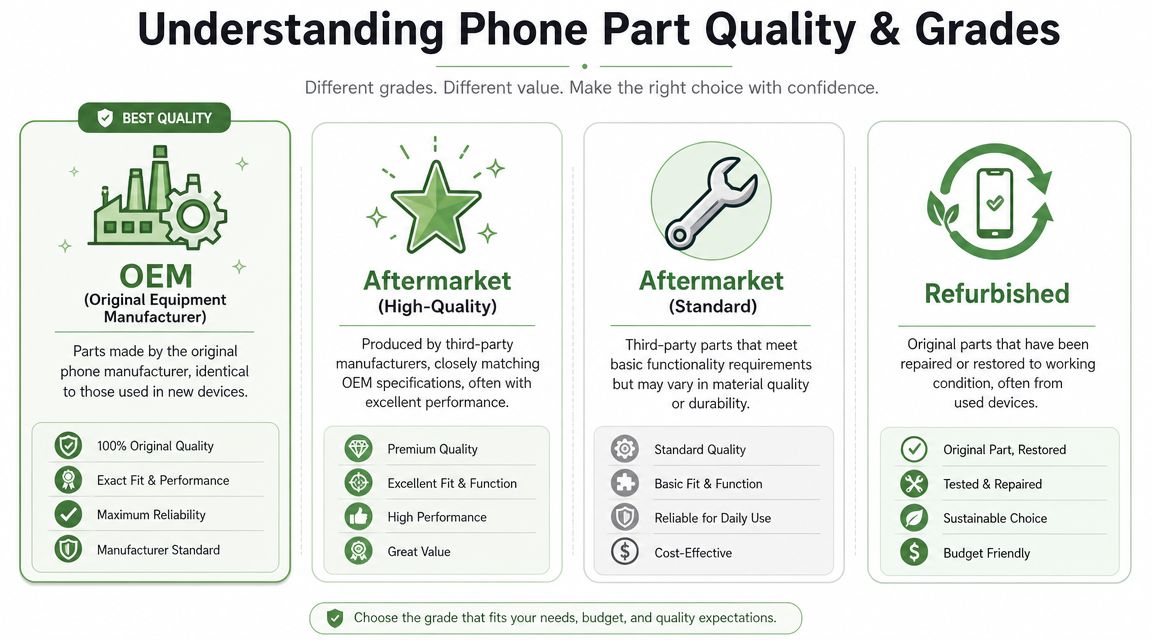
The grades that actually matter on the bench
Think about phone parts the same way mechanics think about car parts. There's the genuine factory route, there's quality third-party replacement, and there's cheaper aftermarket that might only meet the minimum.
Service Pack parts are usually the closest thing to a factory-standard replacement that independent repairers can access through normal trade channels. For Samsung especially, service-pack language tends to matter because it points to a known grade and expected fit.
Refurbished original parts are commonly used for displays. That usually means an original panel has been recovered and restored, often with new glass or refurbishment work. When done properly, this can be an excellent option because core display performance often matters more than a shiny marketing label.
Aftermarket parts sit on a wider spectrum than most new techs realise. A good aftermarket screen can be perfectly serviceable for the right customer and device. A poor one usually shows its weaknesses fast. Lower brightness, weak oleophobic coating, inconsistent touch response, poor frame adhesion, or flex-cable issues are common clues.
OEM is where people get sloppy. In Australia, suppliers and repairers need to be careful about how terms are used. The stronger practice is to separate service-pack parts, refurbished original displays, and aftermarket components clearly, and to prioritise suppliers that can document origin and compatibility because display assemblies and batteries are the highest-impact SKUs in repair work, as noted in this supplier guidance on part sourcing and compatibility.
If a supplier can't tell you exactly what a screen is, assume you're the one taking the risk.
How to read supplier language properly
When a listing says “high quality”, ignore it until the supplier answers practical questions:
- What is the actual grade: Service pack, refurbished original, or aftermarket?
- Is it tested before dispatch: Not “quality checked” in a vague sense, but tested for display, touch, and fitment where relevant.
- What model is it for exactly: Not just “iPhone 12”, but the exact device variant where that matters.
- What happens if it is DOA: You need a clear returns path, not a general promise.
For newer techs, it helps to compare multiple listings for the same model and note what real suppliers disclose. If you want a stronger grounding before buying trade stock, this guide on buying wholesale phone spare parts the right way is useful because it pushes you to check specifications, compatibility, and support details before price.
A good supplier reduces ambiguity. A weak one leaves you to decode the product after you've already installed it.
The Australian Supplier Ecosystem
A Perth shop books three iPhone screen jobs for tomorrow, then finds out the “in stock” parts are on an inbound shipment from overseas. The quote was fine. The margin is gone anyway because the job now needs to be rebooked, refunded, or rushed through with a more expensive substitute. That is how supplier choice hits an Australian repair business. It shows up in turnaround time, customer trust, and dead time at the bench.

Local wholesalers versus overseas suppliers
Australian repairers usually buy through three channels. Local wholesalers. Large overseas distributors. Marketplace or factory-direct sellers.
Local wholesalers suit day-to-day workshop work because they cut delay and admin. If a booking comes in for a common iPhone, Samsung, or Pixel repair, locally held stock gives you a real chance of same-day or next-day completion. Warranty claims are usually easier to process as well, which matters when a technician has already spent labour on the install and needs a clean resolution.
Overseas distributors make more sense for planned purchasing. They often carry older models, awkward variants, and slower-moving parts that local suppliers do not want to warehouse. The trade-off is simple. Longer lead times, more freight planning, and more friction if a part arrives wrong or fails after fitting.
Marketplace and factory-direct buying can still have a place, but only if the shop owner treats it as a controlled sourcing channel, not a shortcut. It works better for low-risk accessories, test orders, or bulk replenishment where you already know the seller and can absorb some inconsistency. If you are building that channel out, learn about importing for Australian businesses before tying core repair bookings to offshore supply.
Match the supplier to the job
Good shops do not pick one supplier type and hope for the best. They assign each source to the kind of work it handles profitably.
| Supplier type | Best use case | Main strength | Main risk |
|---|---|---|---|
| Local Australian wholesaler | Fast-moving repairs and common models | Faster fulfilment and easier support | Narrower range on niche parts |
| Large overseas distributor | Planned bulk orders and obscure parts | Broader catalogue | Longer lead times and harder returns |
| Marketplace or factory-direct seller | Price testing on low-risk items | Lower buy cost | Inconsistent grading and weak after-sales support |
The Australian part of the equation matters more than many newer operators expect. Freight between states is not instant. Cut-off times matter. A supplier with stock in Sydney may still be the wrong supplier for a late-afternoon booking in regional WA or North Queensland. Good purchasing is not just about buy price. It is about whether the part can land in time to keep your board full and your quoted turnaround intact.
That is why many shops keep a short list of local Australian wholesale suppliers even when they also import. The point is not loyalty for its own sake. The point is having a local option for urgent jobs, warranty swaps, and the common models that keep cash flow healthy.
Critical Supplier Evaluation Metrics for Repair Shops
A supplier can look cheap on the invoice and still cost your shop money by Friday. One late shipment, one bad batch, or one messy warranty claim can wipe out the margin on several routine repairs. For Australian repairers, that hits harder because freight times, state-to-state cut-offs, and customer turnaround expectations leave less room for supplier mistakes.
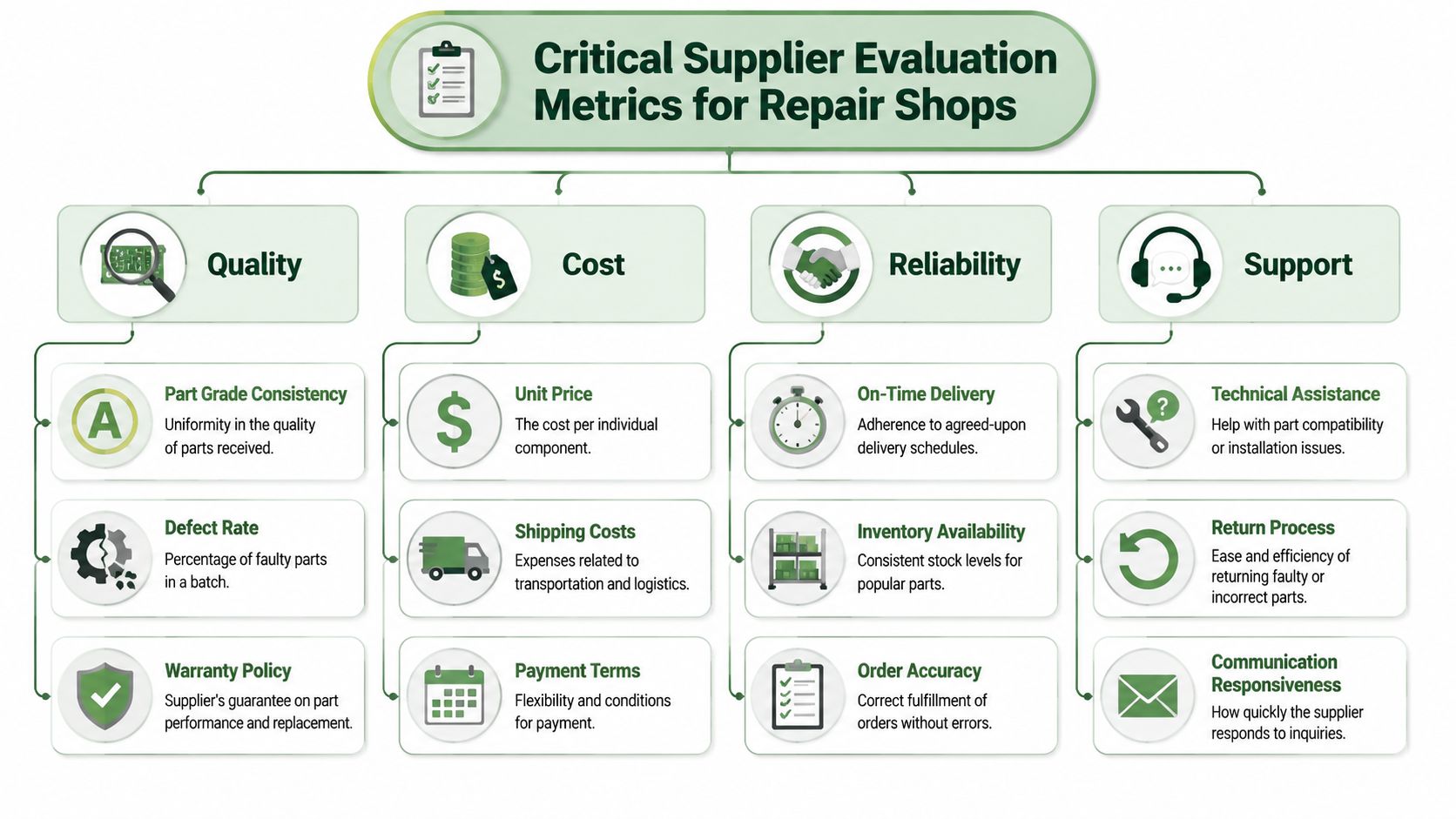
What affects profit
Start with stock accuracy. If the portal says a Samsung service-pack screen or iPhone battery is in stock, that part needs to be on a shelf and ready to dispatch from Australia, not sitting in a purchase order queue. Shops get into trouble when they book work around supplier promises instead of supplier reality.
Next is grade consistency. One clean batch means very little if the next order arrives with weaker oleophobic coating, poor frame fit, uneven brightness, or flex cables that feel flimsy in hand. Consistency matters more than one good first impression because repeatability is what lets a shop quote confidently and keep rework down.
Then look at returns handling. Warranty support only has value if the process is clear and fast. You want to know how DOA parts are assessed, what evidence is required, who pays return freight, and how long replacement approval takes. If every claim turns into a back-and-forth email thread, your staff time becomes part of the supplier's operating model.
Support response time matters too. Bench decisions often happen with the phone open in front of you. If your technician needs confirmation on model compatibility, transferred components, Face ID sensor fit, battery messaging, or warranty exclusions, a reply tomorrow is not support. It is delay.
The better suppliers also make failures easy to track. Batch references, invoice matching, and plain warranty categories save time when a pattern starts showing up across repeat jobs.
The real cost behind a low buy price
Cheap parts do damage in small increments. That is why newer shops miss the problem.
The part price is only the first line on the cost sheet. After that come the costs that hurt profit:
- Bench time: extra testing, extra fitting, or reopening a device that should have been finished once
- Admin time: calling customers, moving bookings, updating notes, and chasing return approvals
- Lost capacity: a redo takes the place of a paid repair
- Refund pressure: some customers will not wait for a second attempt
- Reputation loss: one shaky repair can undo a lot of good local word-of-mouth
Buy on total job outcome, not unit price.
In a busy shop, the difference between a good supplier and a draining one often shows up in labour efficiency. A part that installs cleanly, matches the quoted grade, and holds up through warranty is worth more than a lower-priced part that creates an extra half hour of work.
Questions that separate trade suppliers from order-takers
Ask practical questions before you rely on a supplier for volume:
- How often is stock status updated
- Can they confirm exact model and variant compatibility before dispatch
- Are warranty terms written clearly by part type
- Will support reply during Australian business hours while the repair is still on the bench
- Do repeat orders arrive with the same grade, finish, and included components
Good answers reduce quoting errors, booking delays, and warranty exposure. Weak answers usually mean the supplier is set up to process transactions, not support repair operations.
For Australian shops, that distinction matters. Profit does not come from finding the cheapest screen on a spreadsheet. It comes from using suppliers that help you keep turnaround times, reduce rework, and protect the reputation attached to every device that leaves your counter.
Your Practical Supplier Vetting Checklist
Most repairers don't need a fancy procurement system. They need a repeatable way to stop making rushed buying decisions. A simple checklist does that better than memory.
How to score suppliers for your shop
Use a basic scoring method. Mark each line out of five, then weight the categories according to your work type. A high-volume shop should score logistics and stock depth heavily. A DIY buyer or low-volume freelancer might care more about part guidance and return simplicity.
If two suppliers look similar on price, the checklist usually exposes the actual difference fast.
| Category | Evaluation Point | Notes / Score |
|---|---|---|
| Part quality and consistency | Can the supplier clearly state whether the part is service-pack, refurbished original, or aftermarket? | |
| Part quality and consistency | Do repeated orders arrive at the same grade and finish quality? | |
| Part quality and consistency | Is model compatibility documented clearly enough to avoid guesswork? | |
| Pricing and payment terms | Is the listed price still sensible once shipping and likely rework are considered? | |
| Pricing and payment terms | Are trade pricing, account terms, or bulk options clear if you buy often? | |
| Logistics and shipping | Is the part locally stocked or likely to be supplied as a backorder? | |
| Logistics and shipping | Is there a same-day dispatch cut-off for urgent jobs? | |
| Logistics and shipping | Can the supplier confirm order accuracy before dispatch if needed? | |
| Warranty and returns | Is the DOA process documented in plain English? | |
| Warranty and returns | Are there clear conditions for installed versus uninstalled returns? | |
| Warranty and returns | How much admin is involved in making a claim? | |
| Customer support | Can you get a useful answer on compatibility or quality grade quickly? | |
| Customer support | Does support understand repair language, or only order status? | |
| Customer support | Do they help solve mistakes, or just point back to policy? |
A good shortlist often ends up looking boring. That's a good sign. Reliable suppliers are usually the ones with clear stock info, repeatable quality, and straightforward support. They don't force you to decode the fine print every time you need a charging port, battery, or OLED.
Building a Resilient Supply Chain Strategy
The shops that stay stable don't rely on one supplier and hope nothing goes wrong. They build a system that can absorb delays, grade changes, and stock gaps without blowing up the week's bookings.
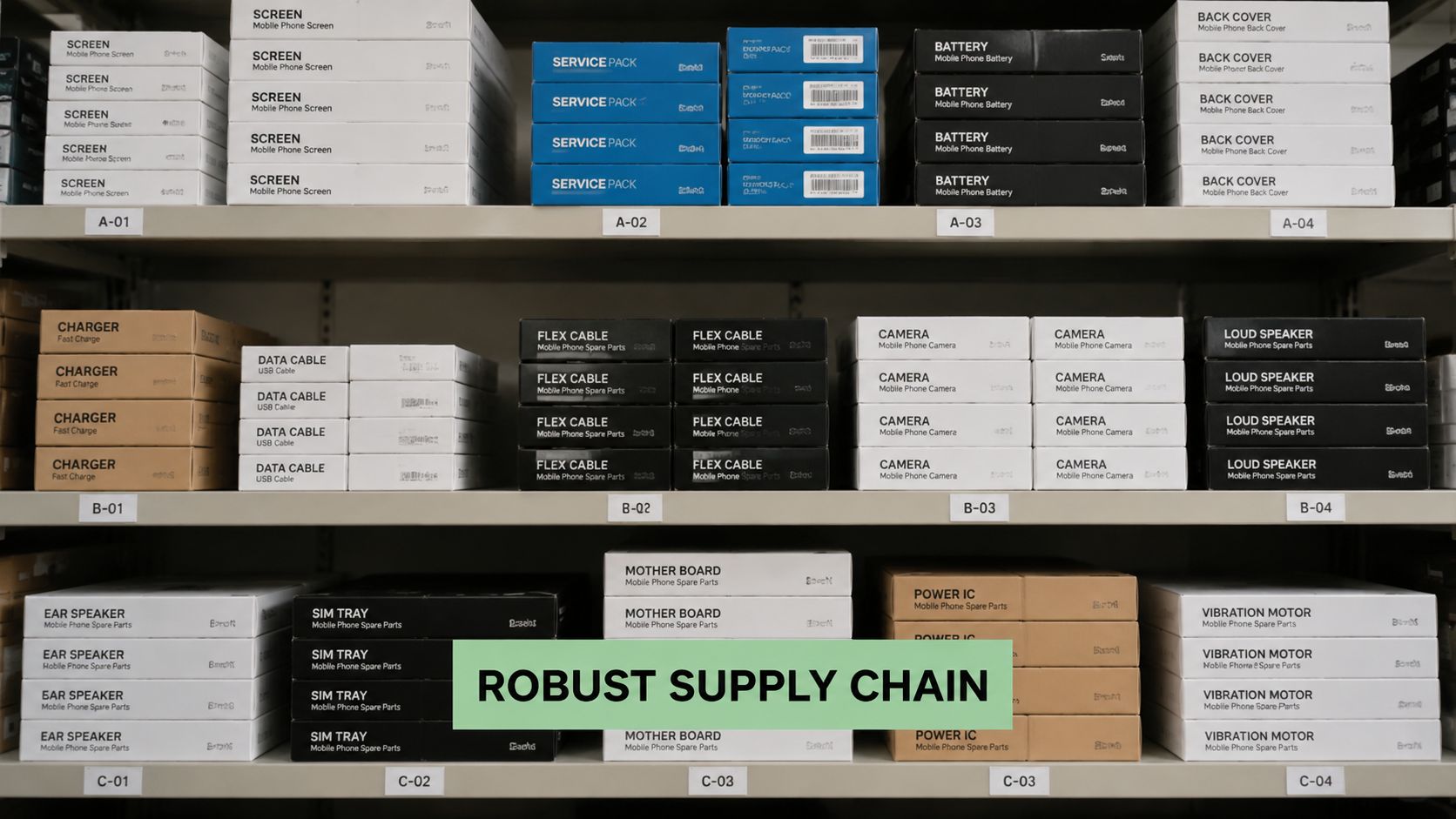
The long-term case for doing this is strong. The global mobile accessories market is projected to grow from USD 302.59 billion in 2023 to USD 426.78 billion by 2030, according to Next Move Strategy Consulting's market report. For Australian repairers, that points to a durable category with continuing demand for replacement parts and accessory stock. If demand stays active, weak sourcing becomes a bigger bottleneck, not a smaller one.
Why one supplier is never enough
Your primary supplier should cover your fastest-moving items. That usually means common iPhone screens, Samsung display assemblies, batteries, charging ports, rear cameras, and adhesive sets. But you also need a secondary source that can step in when a batch changes or stock disappears.
This doesn't mean splitting every order. It means building familiarity with at least two dependable channels so you're not scrambling mid-week. If you want a broader way to think about supplier relationships, Wand Websites' vendor management playbook is a useful planning reference because it frames vendors as operational partners, not just price points.
A backup supplier isn't a luxury. It's insurance against cancelled jobs.
There's also a practical local angle here. Wholesale mobile phone accessories in Australia reflects the kind of local-stock model many repairers use for day-to-day items, where same-business-day dispatch and mixed parts-plus-accessories ordering help keep benches moving.
Stock depth beats catalogue size
A huge catalogue looks impressive. It doesn't help if the parts you sell are always unavailable.
Keep tighter in-house stock on parts that fail often and turn quickly. For most repairers, that means:
- Displays for popular iPhone and Samsung models: These jobs drive walk-ins and urgent bookings.
- Batteries for ageing devices: Battery replacements are steady work and often book on short notice.
- Small parts that stop a whole repair: Charging ports, earpiece meshes, camera lenses, screws, adhesive, and brackets.
- Consumables and tools: Waterproof seal, battery adhesive, pre-cut tape, isopropyl, picks, and pry tools.
A resilient supply chain also means reviewing your own failure patterns. If one model creates more returns on aftermarket screens, stop pretending the lower buy price is helping. Move that model to a higher grade, or change supplier.
A short explainer can help newer techs think through the bigger sourcing picture before they overcommit to one channel:
Good repair businesses don't just buy parts. They design around uncertainty.
Frequently Asked Questions for Australian Repairers
How do I choose a battery that won't cause trouble later
Start by ignoring vague claims like “premium cell” unless the supplier can explain what they mean. Battery quality is one of the biggest information gaps in repair supply. Repairers need clearer guidance on safety, compliance, and how replacement batteries behave after OEM firmware updates, especially as more Australian consumers choose repair-first options, as discussed in this review of common battery-information gaps.
Ask the supplier practical questions. Is the battery tested before dispatch? Is there model-specific compatibility guidance? Are there known calibration issues? What warranty conditions apply after installation? On the bench, also inspect flex quality, connector finish, adhesive alignment, and packaging condition before install.
For battery jobs, don't promise more than the part grade supports. If you're fitting an aftermarket battery, explain that clearly to the customer. Clear expectation-setting prevents more conflict than any script.
Should I import parts directly or buy local
Use local supply for fast-turn work, customer-booked repairs, and any job where downtime hurts more than small price differences. Importing can make sense for planned stock orders, unusual parts, or accessories where lead time is less critical.
The mistake is building your whole operation around the cheapest landed price without considering delays, returns, and communication. If you import, do it deliberately. Group orders properly, track what is worth importing, and keep local backup for the models that pay the bills.
For shops growing past ad hoc ordering, it also helps to think in process terms instead of one-off buys. This overview of API2Cart on supply chain management is useful for understanding why stock visibility, order flow, and supplier coordination matter once your volume increases.
What should I do when parts for a new model are scarce
Don't overpromise repair turnaround when a device is newly released. Early in the cycle, part availability is often uneven, grades aren't always stable, and the first wave of stock can vary more than listings suggest.
For new models, use a stricter buying rule. Confirm exact availability, ask what grade the part is, and avoid locking in too many customer bookings until you've tested the first batch yourself. One successful install tells you more than ten product descriptions.
If the model is too new for dependable supply, offer assessment and delayed booking instead of immediate commitment. Customers usually accept that when you explain it properly.
How do I handle warranty claims with suppliers
Document everything before and during install. Photograph the packaging, label, and part condition. Test displays and batteries before full reassembly where possible. Keep notes on the device model, issue found, and what troubleshooting you completed.
Then keep your claim short and specific. Good suppliers respond better when the report is clean:
- State the exact part and device model
- Describe the fault plainly
- List what testing you performed
- Attach clear photos or video if relevant
Don't wait weeks to report an issue that appeared immediately. And don't mix installer error with supplier fault. If a flex was torn during fitting, own it and move on. Suppliers respect shops that report accurately, and that often improves support over time.
The best warranty process starts before the order. If the supplier's policy is confusing before you buy, it won't become clearer after a failure.
If you're comparing cell phone parts suppliers and want a local option with Australian stock across common repair categories, Fixo supplies phone and smartwatch spare parts, tools, and DIY repair kits for trade customers and home repairers. It's worth checking when you need clear part categories, local dispatch, and support for common Apple, Samsung, Pixel, and other repair workflows.